Before You Burn Out: The Warning Signs You Shouldn’t Ignore
Have you ever had one of those weeks where you’re tired, but you tell yourself, “I just need to get through this week”? You’re sleeping, but you still don’t feel rested. You’re more irritable than usual. Answering a simple text feels like a chore. Or maybe you’ve started fantasizing about canceling every plan you’ve made because you just don’t have the energy. But you keep going because you’re used to keeping going. It has to get done, right?
If you’re reliable and used to taking care of everyone else, it can be surprisingly difficult to recognize when you’re actually approaching burnout. You may notice that something feels different, but instead of slowing down, you likely push through it. The problem is that burnout doesn’t always start with complete exhaustion. In fact, it's insidious, and when left unaddressed, it will make its presence known.
Burnout warning signs aren’t always obvious
One of the most important things you can do to prevent burnout is learn your own warning signs. Burnout symptoms can manifest cognitively (affecting the way we think, not just how we think), emotionally, and behaviorally. And these changes can be subtle at first.
Cognitive signs include difficulty concentrating, forgetfulness, indecisiveness, racing thoughts, or feeling like your brain is constantly overloaded. You might find yourself rereading the same email three times or struggling to make decisions that normally wouldn’t take much effort or thought.
Emotional signs include irritability, frustration, anxiety, feeling detached, becoming more cynical, or losing your usual sense of enjoyment. You might find yourself thinking, “I don’t care anymore,” when you actually care quite a lot.
Behavioral signs can look different from person to person. You might withdraw from friends, procrastinate more, work longer hours, stop exercising, skip meals, overcommit yourself, or rely on coping strategies (e.g., doomscrolling or drinking) to get through the day that don’t feel restorative (but it’s something, right?)
And here’s the tricky part - you might not immediately recognize these things as burnout. You may be prone to describe how you feel as “off”, “lazy”, or “dramatic”, and try to maintain perspective by reminding yourself that “Other people have it worse.” While true, dismissing your warning signs does not cure your burnout or the situations that are worse than yours. In fact, this is the perfect recipe to maintain your burnout symptoms!
Why noticing sooner matters
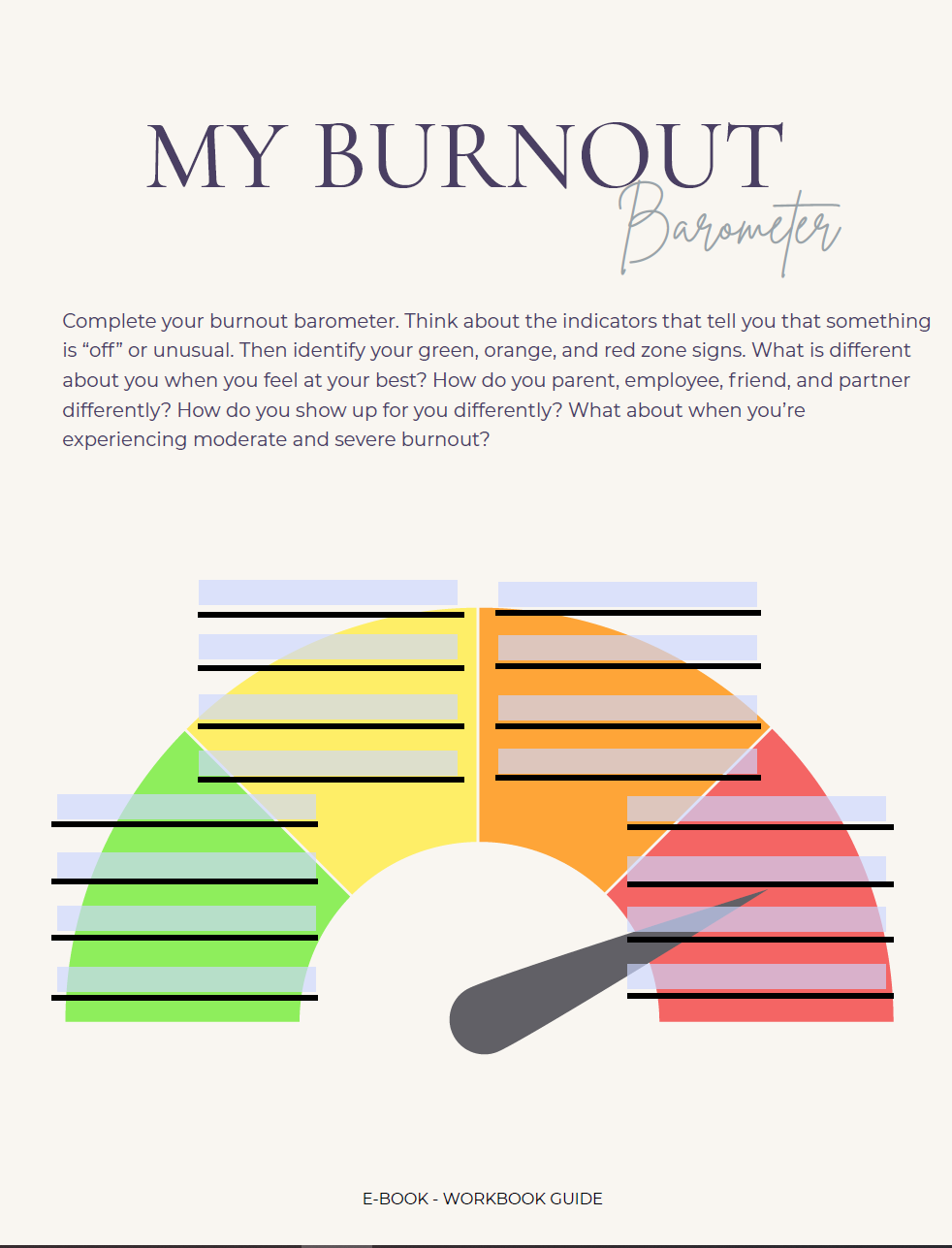
The earlier you recognize your burnout warning signs, the more opportunity you have to respond to them. This is especially important if you’re someone who struggles with asking for help. The sooner you catch yourself creeping toward burnout (moving from the ‘optimal’ green zone to the red zone, indicative or severe burnout), the sooner you can say “no” to that additional responsibility, address your worry about disappointing others, and take that break without guilting yourself for it.
This is where people-pleasing and hyperindependence can make burnout harder to recognize. You’re not necessarily ignoring your needs because you don’t know they exist, but you may be ignoring them because you’ve learned that your needs can wait. But eventually, your body and mind may stop giving you subtle signals.
What happens when you ignore the warning signs?
Ignoring burnout warning signs doesn’t make them disappear. Often, they become harder to manage. In fact, mild burnout symptoms can take months to recover from, while severe symptoms can take years. The occasional brain fog can become persistent difficulty concentrating. Irritability can turn into resentment. A little fatigue can become complete exhaustion. Left untreated, mild-to-moderate symptoms of burnout will progress to severe burnout, depression, and anxiety disorders.
Factors influencing burnout recovery windows include:
The length of chronic stress exposure
The severity of burnout symptoms
Access to support, including therapy, medication management, and supportive community
Lifestyle factors, including sleep, nutrition, financial resources, and physical activity
And when you’ve waited until you’re completely depleted, recovering can require significantly more time, support, and change than it might have taken to address the early warning signs. That’s why learning your personal burnout warning signs matters. You don’t need to wait until you’re completely burned out to decide that something needs to change.
You don’t have to wait to address your burnout warning signs
Understanding your warning signs is one piece of learning how to manage burnout differently. In my e-book, How to Beat Burnout Without Quitting Your Job, I walk you through the practical steps to help you recognize what your burnout looks and respond before you reach the point of complete exhaustion.
We’ll dig deeper into the warning signs, the beliefs that can keep you stuck in the cycle, and practical strategies for creating more space, support, and boundaries in your life. Because the goal isn’t simply to survive another stressful week - it’s to learn how to recognize when you’re running on empty and actually do something about it.
Ready to understand your burnout before it takes over? Purchase How to Beat Burnout Without Quitting Your Job and start learning how to recognize your warning signs, protect your energy, and make meaningful changes without walking away from the life you’ve worked so hard to build.
Other Services I Offer in Bryant Park, Manhattan & Beyond
Life brings many unique challenges, and I am here to support you every step of the way. In addition to burnout therapy, Lavender Therapy offers specialized services to help you navigate through different phases and experiences. Anywhere in New York and New Jersey, I offer therapy for postpartum and pregnancy concerns, therapy for women, and family planning therapy.
About The Author:
Dr. Ruby Rhoden is a New York and New Jersey-based Licensed Psychologist who is dedicated to uplifting women through life changes and challenges, including reproduction. She understands how unhelpful behavior patterns and mental health disorders uniquely impact women and uses evidence-based techniques to usher in sustainable change and relief. With a focus on helping clients reconnect with themselves and find effective self-care strategies, Dr. Ruby provides personalized therapy to address the root causes of burnout. Dr. Ruby is also dedicated to helping women develop healthier habits and relationships with themselves and their bodies so that they can connect to others and the world around them again. Dr. Ruby studied at Cornell University and Rutgers, The State University of New Jersey for her Bachelor's and Doctoral degrees, respectively. In her free time, she enjoys watching reality TV, supporting small businesses, and writing blog posts to remind all women that they are not alone.